
Clark County Criminal Docket Searches
The public route to a Clark County criminal docket runs through Missouri Case.net. That is a statewide judiciary service rather than a private county database. The Clark County Circuit Clerk sends traffic, misdemeanor, and felony users there. If a court paper shows a case number, type it in exactly. Without one, search by litigant name. Where the live form allows, limit results to Clark County or the First Judicial Circuit.
Case.net adds filing-date and Scheduled Hearings & Trials searches. Keep one thing straight about filing dates. They mark when the case entered court, not when an alleged event occurred. A name match is only a lead. So compare the court location, case category, case style, filing date, and case number before trusting a result as your Clark criminal case. The public view tracks case activity well. A clerk-certified copy is still a separate court record.
- Keep the case number from a notice if available. If not, record the party name as it appears on the court paper.
- Open Case.net and choose Case Number Search for the exact identifier or Litigant Name Search for a party name.
- Use the Clark County or First Judicial Circuit location control when it appears, then confirm the criminal category in the matching result.
- Open the case and read the Case Header, Parties & Attorneys, Docket Entries, Charges/Judgments/Sentences, and Scheduled Hearings tabs in that order.
- Ask the Circuit Clerk for the current procedure if a document is needed as a plain or certified court copy.
Case.net Routes for Clark Criminal Dockets
Case.net splits its Clark County court docket tools into separate routes. Each one answers a different question. Case Number Search is the best option. It works when you already have the number. Litigant Name Search helps when a notice has gone missing. Common names call for slow, careful comparison before you trust a match. Filing Date Search suits situations where you know roughly when a case began and want cases from that window. Scheduled Hearings & Trials serves a narrower purpose: it shows what is currently set on the calendar. It will not walk you through a full case history. Use the other routes for that.
| Route | Use it for | Clark check |
|---|---|---|
| Case Number Search | An exact case from a notice or court paper | Keep the year, location, category, sequence, subcase characters, and hyphens. |
| Litigant Name Search | A party whose case number is unknown | Add first or middle information and compare the court and filing date. |
| Filing Date Search | A known court filing period | Do not use the alleged-event or traffic-stop date as the filing date. |
| Scheduled Hearings & Trials | An upcoming setting | Select Clark or First Circuit and review the latest setting in the case afterward. |
You do not need a Missouri eFiling account to use public Case.net for a Clark County docket search. eFiling is a separate, secure layer. Courts, attorneys, and authorized filers use it to submit documents. Those extra permissions still do not make every docket attachment viewable from home. Per the court's File Viewer materials, a linked docket entry opens a file only under one condition. The viewer must already have access to it.
Criminal Dockets: What They Show
Think of a Clark County criminal docket as a chronological register of the case. The header comes first. It identifies the court and location, the criminal case type, the case number, the filing date, the case style, and the current status. Below that, the parties area names the State or other prosecuting party, the defendant, and each attorney's role. The detailed docket entries then track everything that moves the case. Filings, service, hearings, pleas, orders, judgment events, sentencing, and later post-judgment activity all appear there. Many case records also carry a public view. It covers the charge, statute or charge code, classification, bond activity, costs, and scheduled hearings.
| Case number | Current Missouri numbers use a year, location identifier, category, sequence, and subcase construct. A criminal category can appear as CR; older converted cases can use a different construct. |
|---|---|
| Case Header | Court/location, filing date, case type, style, and current status establish that the record belongs to the Clark case being sought. |
| Charges and outcome | Where public, the view can show charge description, statute or code, classification, plea, disposition, judgment, and sentence information. |
| Docket Entries | The register lists filings, motions, service, hearings, orders, plea events, sentencing, and later activity in date order. |
| Scheduled Hearings | An entered setting can show date, time, court/location, judge, and event type. Read the newest setting or reset entry. |
A charge is only an allegation, never a conviction. A court date or arraignment entry marks a stage, not a ruling. Before you describe any outcome, read the newest judgment or disposition entry along with any available order.
Clark Criminal Docket Status Codes
Short codes on a Clark criminal docket rarely tell the whole story. One label is just the system's record type. Another, a disposition label, records an actual result entered by the court. Bond entries work differently still. They describe the conditions tied to release or to showing up for a hearing. Missouri's official materials give examples of several coded entries, and they help with the vocabulary. Even so, read any live case in context. Pair the code with the surrounding docket lines and the order itself.
- CR
- A current Missouri case-category shorthand for a criminal case. It does not describe the charge or result.
- TR and MU
- Traffic and municipal-ordinance categories. Their presence identifies a category, not whether a person was found responsible.
- BFORJ
- An official manual example for bond-forfeiture judgment entered. It concerns a bond event and is not a substitute for reading the case status.
- BREL
- An official manual example for bond released.
- Nolle prosequi
- A prosecutor’s formal abandonment of a charge. Public access to related records still follows Missouri confidentiality rules.
Clark County's Prosecuting Attorney page names a key player in criminal cases there. That office does not keep the docket, though. Case numbers, docket entries, hearing questions, and certified court copies all rest with the Circuit Clerk, whose official page shows the prosecutor's role.
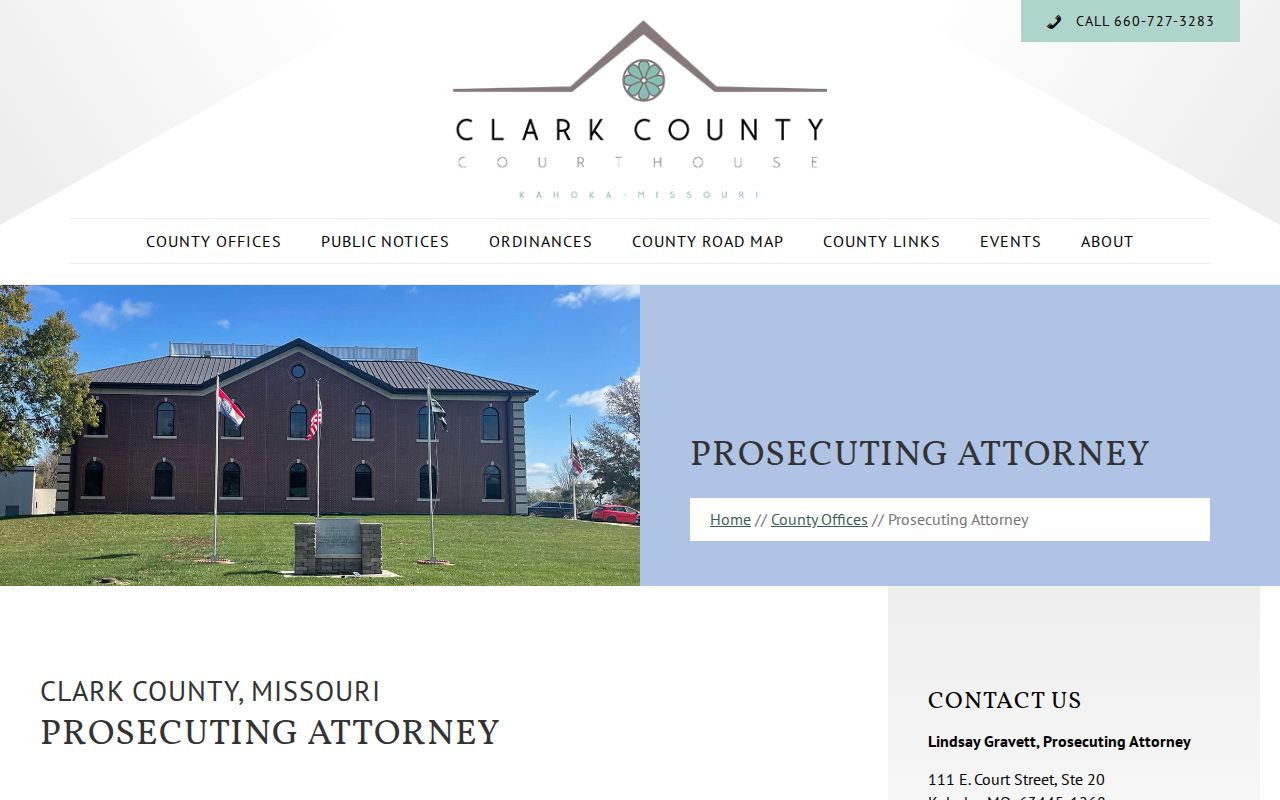
Clark County's Prosecuting Attorney page names a participant in criminal cases. The prosecutor does not keep the docket. Case numbers, docket entries, hearing questions, and certified copies all belong with the Circuit Clerk.
Criminal Case Stages on the Docket
A Clark criminal docket usually opens with a filing or charge entry. From there, arraignment or initial appearance lines may note a plea, name counsel, or set the next hearing date. The pretrial stretch tends to get busy. Motions, discovery filings, status settings, and continuances pile up in this part of the record. A reset only moves a setting to a new date. It never means the charge was dismissed. Toward the end, entries capture the plea or trial, the judgment and sentencing, plus any appeal or other post-judgment activity.
Docket flow: Filing or Charge › Initial Appearance or Arraignment › Pretrial Activity › Plea or Trial › Judgment or Disposition › Sentencing or Post-Judgment Activity
Track the dates instead of trusting one status word. A short docket line can leave out details that the actual order contains. Notices of appeal and mandates also matter here. They can point to a separate appellate record. The Clark trial docket stays distinct from that later case. It sits with the Missouri Court of Appeals, Eastern District.
Why Clark Tickets Take 25 Days
New Clark County traffic cases do not appear instantly. Case.net can take up to 25 days to show a fresh citation. A ticket you hold may still be valid even though the docket search returns nothing. Wait before assuming the citation vanished. Were you issued two citations on the same stop? Search by name instead of case number. One ticket number often works. The other has not reached the clerk for entry yet. That name search is the faster route during the 25-day window.
Practical check: Keep the citation, search the party name as printed, and wait for the local entry window before treating a missing Clark traffic result as proof that nothing was filed. For a hearing or payment question, contact the Circuit Clerk instead of guessing from an incomplete search.
Missing an older case on the docket calls for a different kind of question. Ask the Circuit Clerk what form the record takes. It might sit in paper, on microfilm, or in the electronic system. It could also sit under a seal, an expungement order, or another division entirely. Clerk staff will walk you through how to reach the record. They draw a firm line there. They cannot tell you what a criminal entry means for your situation or suggest what you should file.
Clark County Criminal Docket Courts
Clark County belongs to Missouri's First Judicial Circuit. Under the First Judicial Circuit local rules, Division One is the Clark County Circuit Court, and Division Two is the Clark County Associate Circuit Court. The Circuit Clerk's public case list covers misdemeanor and felony criminal cases alike. Want the true division for a specific criminal matter? Read it from the Case.net header or confirm it with the clerk. Guessing from the charge level alone is a bad habit.
The same courts also take traffic and municipal matters when those routes are assigned, while juvenile cases and other protected matters carry their own confidentiality limits. Clark publishes no separate county criminal-docket portal. Case.net serves as the shared public starting point for a Clark County court docket search, and the Circuit Clerk backs it up locally with case numbers, setting questions, in-person inspection, and formal copies.
| Clark division or route | Docket role | How to confirm |
|---|---|---|
| Division One Circuit Court | Circuit-level criminal matters and matters assigned to the circuit division | Read the Case.net court/location header or ask the Circuit Clerk. |
| Division Two Associate Circuit Court | Associate matters, including matters assigned by statute or the presiding judge | Confirm the division in the case header and current setting. |
| Municipal route | Municipal-ordinance cases when filed through the Circuit Court system | Use the Case.net category and clerk routing, not the city name alone. |
Clark Criminal Docket File Access
Seeing a docket entry is one thing. Reading the file behind it is another. Missouri's Case.net File Viewer information spells this out: a hyperlinked entry may open a document. Whether it opens at all depends on that document's security settings and your permission as a viewer. An entry with no link means one of two things. Either no attachment exists, or that attachment stays closed to you. An ECASE label tells you the whole case file is electronic, with no paper file behind it.
If a public document will not display remotely, use the courthouse public-access terminal. You can also ask the Circuit Clerk directly. The records desk sits in Suite 210 at 111 E. Court Street in Kahoka. Call 660-727-3292 with the case number in hand. Say plainly whether you want the docket sheet or a specific document, plain or certified. Clark County has posted no criminal copy-fee schedule of its own. Get the current quote before you pay anything.
The official Missouri court-record rules lay out the uniform record system and the role of docket sheets. They also cover public-access equipment and the controls that govern who may see what.
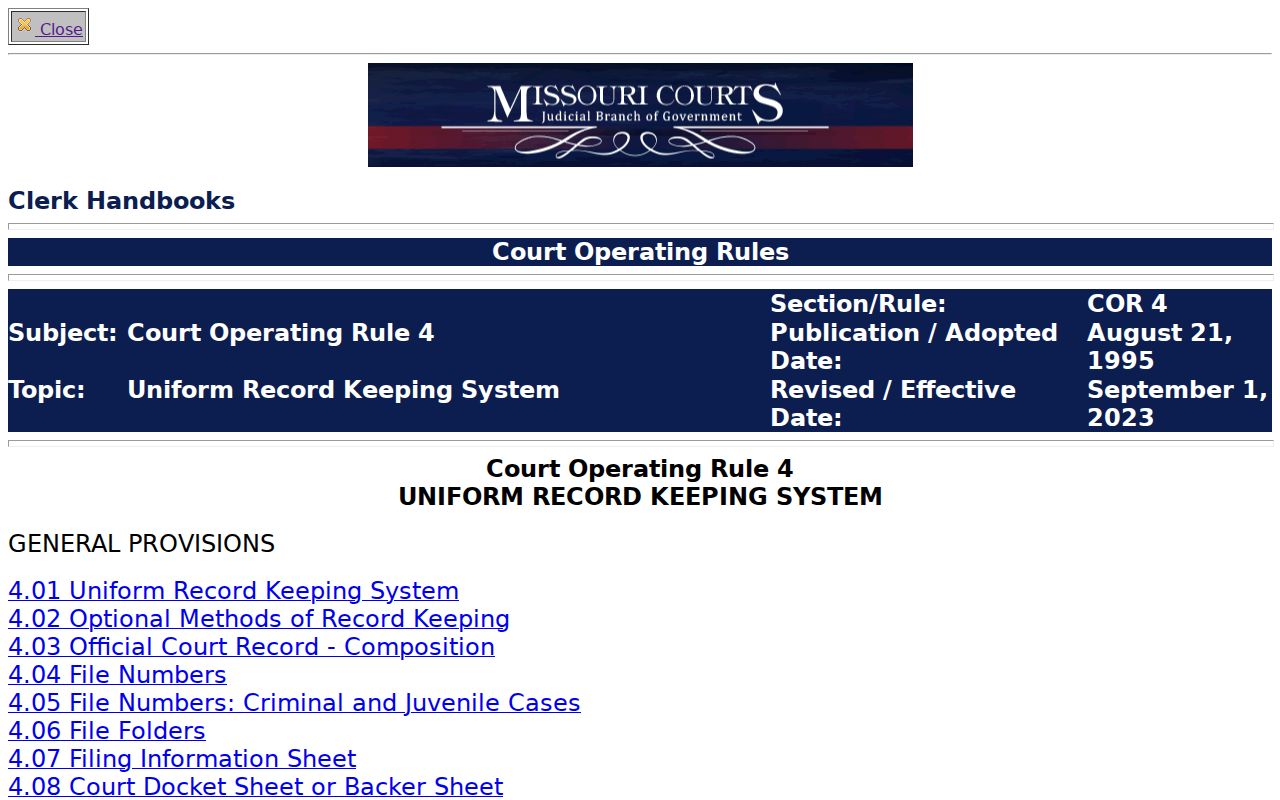
That rule framework has a practical payoff. A public docket entry can steer you to the case, while the filing you want may still need a different lawful access channel.
Clark Criminal Treatment Case Numbers
Official 2025 Missouri procurement material names Clark County, in the First Circuit, as served for treatment-court services. Those services cover DWI, adult, veterans, and juvenile treatment courts. A treatment case often stays under its original criminal case number. Program details may be confidential or security-limited. So a special program label neither creates a separate public Clark docket portal nor opens its documents to view. It does not start a new case on its own.
Start with the ordinary Case.net criminal case header and docket number. A treatment-court tie-in can raise an access question. The Circuit Clerk can say whether a public terminal, a clerk request, or another lawful route fits. Clark County offers no separate mental-health court portal or distinct public treatment-court docket. Confirm an unfamiliar label with the clerk rather than treating it as a new case number.
Access Rules for Criminal Dockets
Public Case.net results can display a header, entries, settings, charges, judgments, and dispositions where access allows. Still, not every criminal record shows up there. Juvenile and mental-health records, protected-person material, sealed filings, expunged records, and some warrant material may be missing or trimmed. A name search can come back empty. The reasons vary: confidentiality, a protected party, a fresh Clark ticket, the wrong circuit, or a different case-number build. It cannot prove that no criminal case exists. Only the court record itself, checked case by case, settles that.
Missouri access rules:
Court Operating Rules 4.02 through 4.26 maintain court records and control access to confidential, sealed, and expunged material.
RSMo §610.105 addresses closure of certain terminated criminal records while allowing final action or judgment access as the law permits.
RSMo §610.140 provides the Missouri court procedure for qualifying expungement petitions and makes affected records confidential after an order.
A visual reference from Missouri's closed-record statute shows why final action and full-file access can part ways.
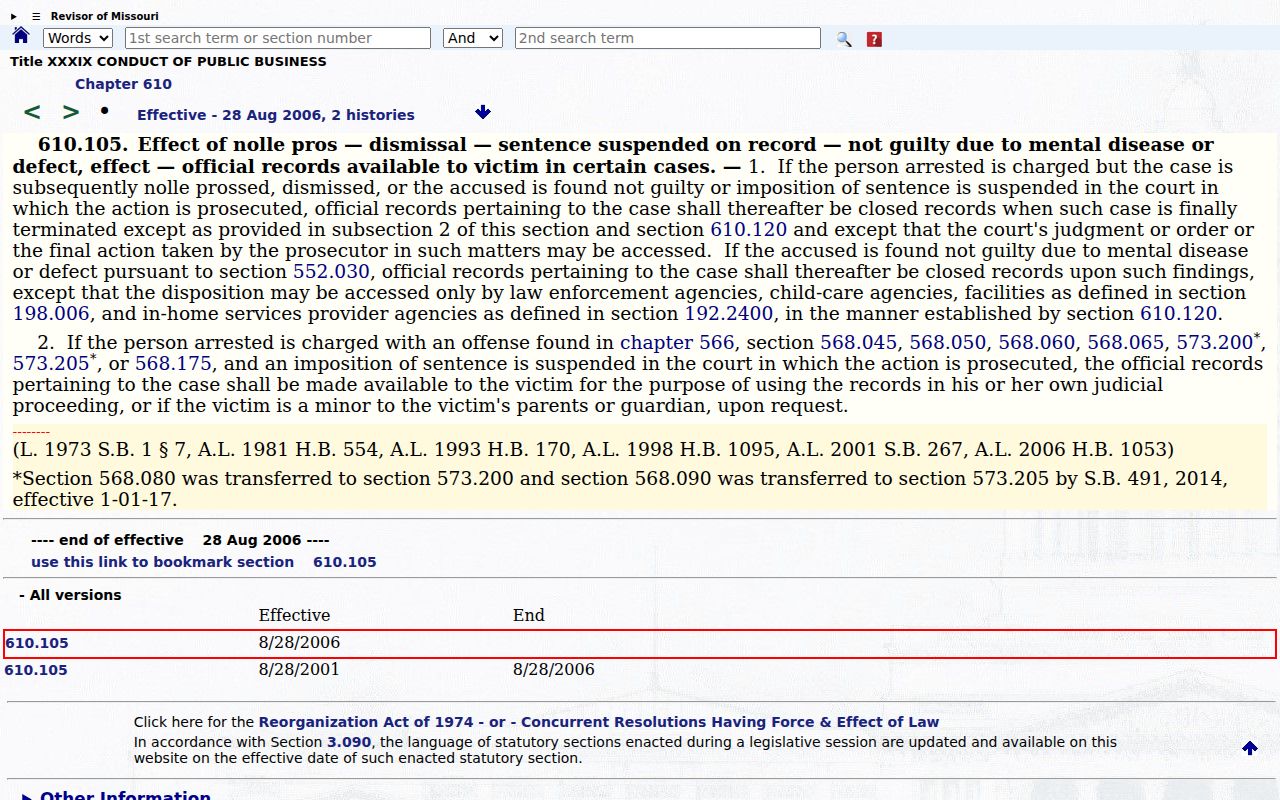
Even so, the result still needs case-specific confirmation from the court record, especially where a clerk flags an access limit.
A second official reference is Missouri's expungement statute. It governs both the procedure and the confidentiality effect of a qualifying expungement order.
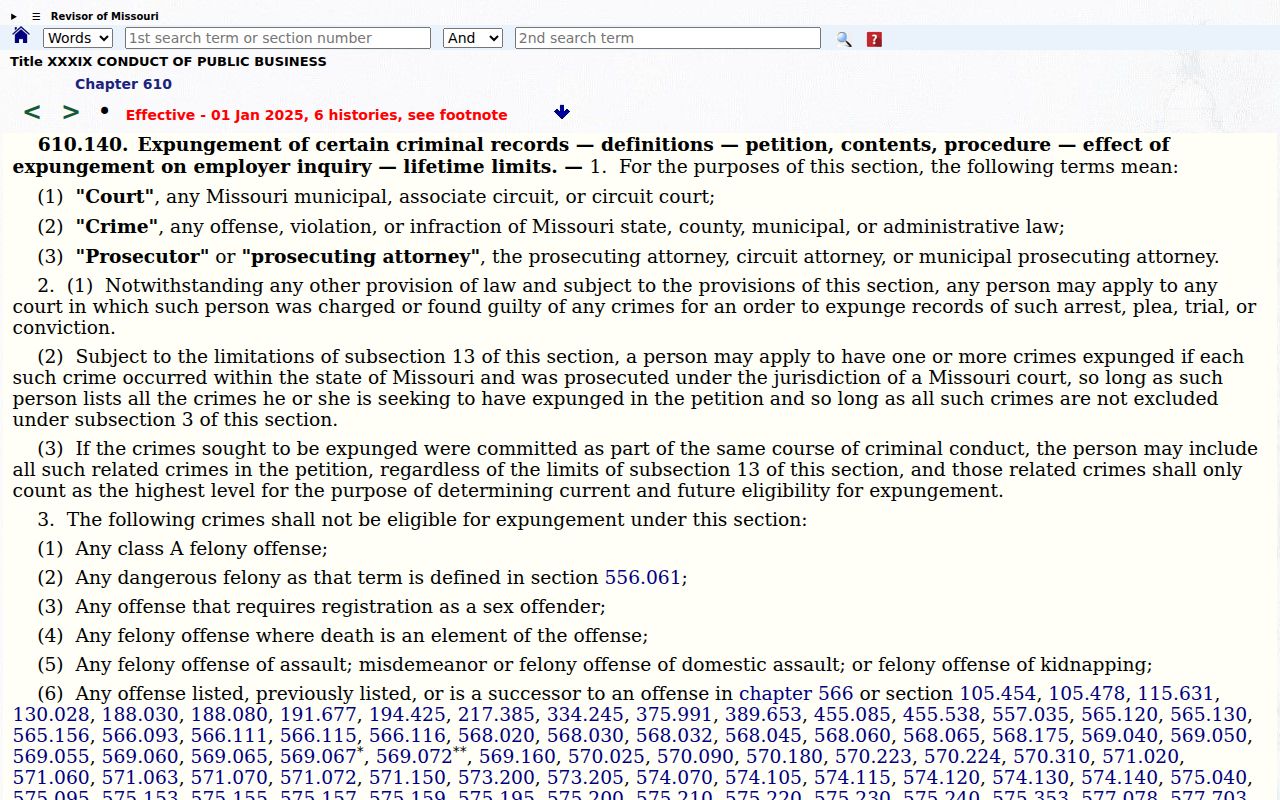
If a request gets denied, ask the Circuit Clerk to cite the rule or statute behind it and to point out the lawful route for review. Never try to slip past the court's security controls.