
Clark County Court Record Requests
Work in that order: find the case, name the exact record, then ask the right office for access. Missouri Case.net is the public search layer for Clark County Circuit Court cases, and it typically shows the case number, case style, dates, docket entry titles, and links to public documents. The Clark County Circuit Clerk keeps the local court file itself, so the official docket sheet, an inspection, or a plain or certified copy all come from that office.
Public routes into a Clark County court record include Case.net, the clerk's Suite 210 counter, the clerk's direct phone line, the courthouse public terminal, and a narrow written contact once the method is confirmed. The county page says fines may be mailed. No general docket-copy mail form or court-record request form is offered, so confirm the method, amount, and recipient before sending money or original documents.
- Search Case.net by exact case number or by name and confirm the Clark County/First Judicial Circuit header.
- Open Docket Entries and identify the specific docket sheet, order, judgment, motion, or other record needed.
- Check whether the entry has a public document link and whether that image is the exact record sought.
- Call the Circuit Clerk when the document is missing, old, unlinked, terminal-only, or restricted.
- State whether a plain, certified, or authenticated copy is required and request the current fee and delivery instructions.
Clark County Docket, Document, Copy
Three terms get mixed up constantly. A docket, or register, is the chronological index of filings, settings, orders, and outcomes in a case. The filed document is the actual item behind an entry. It may be a petition, motion, order, judgment, or exhibit. A certified copy is a reproduction of a specific court record. The clerk has certified it. A printout of a web screen is handy for reference, but it is not a certified court copy.
| Record type | What it provides | Clark County route |
|---|---|---|
| Docket sheet | Chronological case activity and settings. | Case.net when public, or the Circuit Clerk. |
| Filed document | The paper or PDF behind a docket entry. | Public link if accessible; otherwise terminal or clerk route. |
| Plain copy | A reproduction without clerk certification. | Ask the Circuit Clerk for current process and fee. |
| Certified copy | A clerk-certified record for formal use. | Request from the Circuit Clerk, not by printing Case.net. |
The difference matters most when a record must serve as formal proof. An order, judgment, or disposition often needs a certified copy to carry weight. A public docket entry can point you to the event, yet it does not by itself deliver the signed record or the clerk's certification.
Kinds of Court Records
The Clark County Circuit Clerk's case list runs wide: traffic, misdemeanor and felony criminal, ex parte protection, small claims, circuit and associate civil, domestic relations, child support, probate, juvenile, adoption, and termination-of-parental-rights matters. Each category can carry its own public entries and its own access rules. Case.net may be the common search door, but the case type and the record's security setting decide what a public user can see or request.
- Docket sheets and chronological Docket Entries.
- Orders, judgments, notices, and service returns.
- Pleadings such as petitions, complaints, answers, motions, and affidavits.
- Criminal charge, disposition, sentencing, bond, and hearing information where public.
- Civil judgment, garnishment, execution, satisfaction, and appeal entries where public.
- Probate and family records subject to the applicable security rules.
Juvenile, mental-health, sealed, expunged, protected-party, adoption, and similar confidential material may be missing or limited in any view. So treat a broad case-type list as a map of what the court handles, not a promise of remote document access.
Clark County Circuit Clerk Copy Route
Kimberly A. Schantz-Smith is the elected Clark County Circuit Clerk and the local court-record custodian. Her office sits at 111 E. Court Street, Suite 210, Kahoka, Missouri 63445-1268. The direct line is 660-727-3292. The counter is open weekdays from 8:00 a.m. to noon and 1:00 to 4:00 p.m. Staff can walk you through procedure, track down a record path, and take permitted payments or filings. They can explain access. They cannot give legal advice.
Clark County Circuit Clerk
111 E. Court Street, Suite 210
Kahoka, MO 63445-1268
660-727-3292
Fax: 660-727-6919
Weekdays, 8:00 a.m.–noon and 1:00–4:00 p.m.
Do not confuse the two clerks. The County Clerk, in Suite 110, handles county administration and elections, not Circuit Court dockets. A case-file request belongs with the Circuit Clerk alone, not the County Clerk and not the prosecutor's office.
Court Records: What They Contain
A public Case.net case view sorts information into a case header, parties and attorneys, Docket Entries, and scheduled hearings. Case-specific charge, judgment, or civil tabs round it out. A document link may sit alongside an entry. How much detail a public user sees varies with the category, the filing date, and the security setting. The most reliable request uses the case number. It should also name the exact docket-entry title, rather than a general summary of the case.
| Case Header | Case number, court location, type, filing date, style, and status. |
|---|---|
| Parties & Attorneys | Party roles and counsel of record where public. |
| Docket Entries | Chronological filing, service, setting, motion, order, judgment, and disposition activity. |
| Document link | A potential attachment route, subject to access permission and availability. |
| Scheduled Hearings | Date, time, court or location, judge, and setting type where entered. |
| Certification | Clerk-issued authentication requested separately from the online display. |
Clark County ECASE Record Access
ECASE means the case file is electronic rather than paper. It does not mean every attachment is reachable from a remote device. Missouri File Viewer guidance explains the split. A hyperlinked docket entry may lead to a document. A non-hyperlinked line can mean there is no attachment. It can also mean the document is not available to the current viewer. Remote access also turns on public-document status, filing date, and case security.
When a public document will not load remotely, the courthouse public terminal is the fallback. Ask the Circuit Clerk whether the item is terminal-accessible, paper, microfilm, electronic, restricted, sealed, or simply not attached. A terminal gives lawful public access. It is not a way around confidentiality rules or a court order.
To locate the case before asking for any document, start with Clark County docket search. A missing document link is a cue to identify the right access channel. It is not proof that the filing never happened.
Copy Fees and Certification
The official material lists no Clark County plain-copy, certified-copy, authentication, or search fees. The First Judicial Circuit local rules do list filing and service deposits. But those figures are not a court-record copy schedule. Never convert a filing fee into a copy price. For the current quote, payment options, delivery method, and certification of a given record, call the Circuit Clerk.
| Item | Research-supported status |
|---|---|
| Ordinary public paper copies | RSMo §610.026 sets a general public-record paper-copy ceiling, subject to its duplication and research rules. |
| Clark court plain or certified copy | Current amount not located; request a clerk quote. |
| First Circuit filing deposits | Local filing and service amounts, not a certified-copy schedule. |
| Transcript | A separate reporter record and possible separate request route; Clark-specific quote not located. |
Ask for a certified copy the specific way. Give the clerk the case number, the case style if you know it, the document title, and its date. That detail lets the clerk pull the right court record fast. Your note will not read like a legal question. Say which copy type you want, how many copies, and where to send them. You can also say how to reach you.
Old Clark County Court Records
Records from Clark County's past may not sit in the usual place. Missouri Court Operating Rule 4 lets courts keep files in more than one form. Courts may use paper, microfilm or microfiche, or electronic storage. The county's 1872 courthouse came down in 2010. The current one was finished in 2012. Don't assume that demolition erased the old files. For a docket search, this means the Circuit Clerk may have to check paper, microfilm, or converted indexes. The clerk may even need an older case-number format rather than a modern screen.
Lead with the basics when you request an old file. Give the approximate year, case number if you have one, party name, and the type of record. An old case lookup may turn on a converted case number. The clerk can then say whether the file is open for public inspection. It may be viewable only on a terminal. It may also be blocked by a restriction.
Access Rules for Court Records
Public access to court records only goes so far. Missouri's court operating rules demand a uniform record system and public-access equipment. Yet they also shield confidential, sealed, and expunged files. So a Case.net search may return just a partial header and disposition. Or it may return nothing at all. That happens with juvenile matters, protected-party cases, and mental-health cases. It also happens with anything sealed, expunged, or under security control. To get such a court record, cite the legal authority that allows you in. A court order works too.
Clark County record authorities:
Missouri Court Operating Rule 4 addresses docket sheets, recordkeeping, public equipment, and access-controlled court records.
RSMo §610.023 supplies a public-record request framework for governmental custodians and requires prompt action or a statement of the lawful denial basis.
RSMo §610.120 addresses access to closed criminal records.
See the official closed-record statute used for this court-record access image.
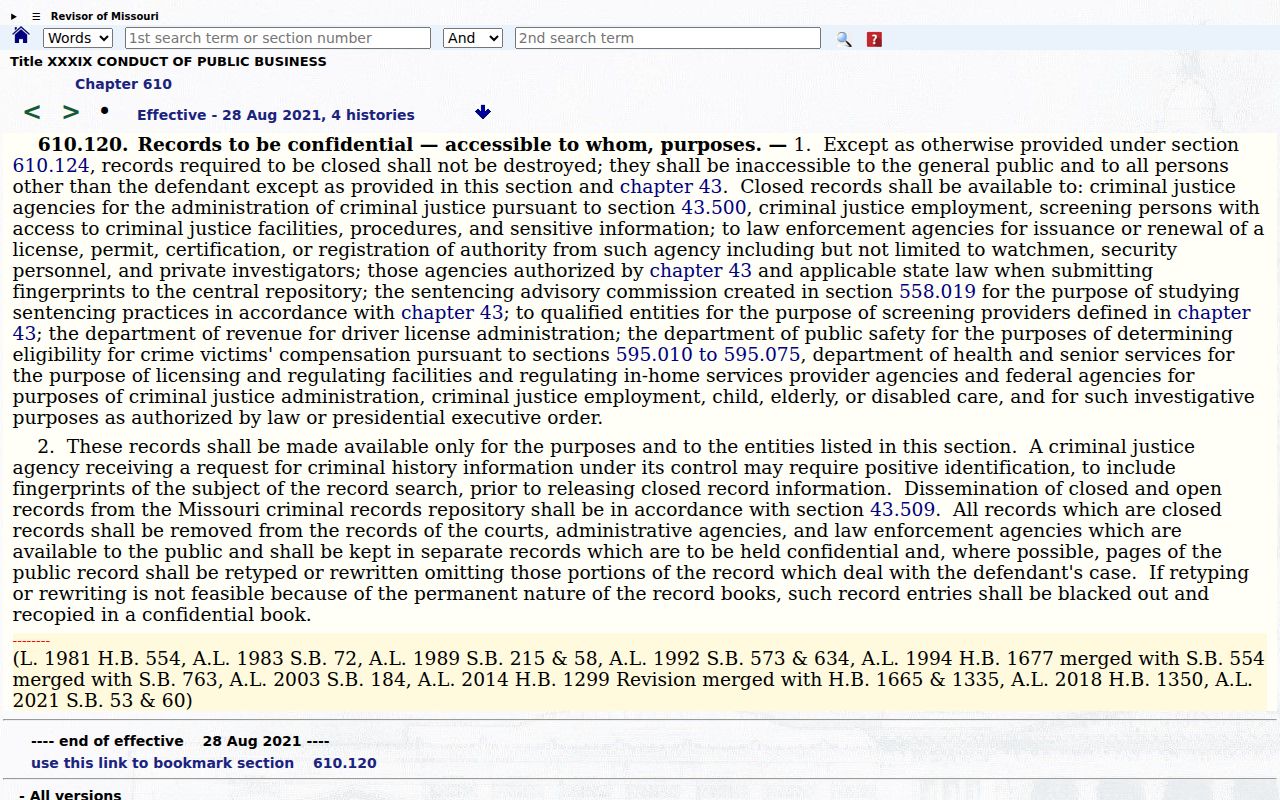
The statute shows why one record may be public and the next one closed. Each court-record request turns on the case itself, not on a blanket assumption that every file looks the same.
Clark County Written Record Details
One tight written request beats asking for a whole case history. List your contact information, the case number, and the case style if known. Name the exact docket or document you want. Add the entry or filing date, whether you need plain or certified copies, how many, and your preferred return method. Clark County has no adopted general court-copy form. So treat this as a checklist, not a claim about an official form.
If the Circuit Clerk says a record is not public, ask which rule, statute, or order applies. Ask what review or court-order route exists too. A name search, an outside result, or a public terminal is not a way around an access restriction. Access to the court docket rests on the record itself. It also rests on the authority behind your request.